

Macula

The macula is an area of the retina, it consists of about 5% of the retina and is responsible for about 35% of the visual field. The remaining 65% (the peripheral field) is not affected by the disease. When the central vision is not working properly it is blurred. Macular degeneration impairs both near and far vision. Patients over 50 years of age may show the first signs of the disease. Factors that accelerate it, such as smoking, high cholesterol and lifestyle.
Symptoms

- Visual acuity is drastically reduced
- Blurred vision
- Central scotoma (shadows or missing areas of vision).
- Distorted vision. A grid of straight wavy lines appears and part of the grid may appear blank.
- Drusen Pigment changes Anti-exudative changes
- Haemorrhage in the eye, hard exudate, subretinal / sub-RPE / intraretinal fluid
- Atrophy
- Atrophy There is a loss of contrast sensitivity, so that contours, shadows, and color vision are less intense.
Similar symptoms with a very different etiology and different treatment can be caused by Epiretinal membrane or macular pucker or leakage of blood vessels in the eye.
Diagnosis
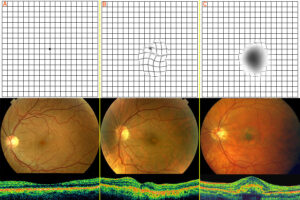 The diagnosis is usually made through an ophthalmological examination carried out by a specialist ophthalmologist:
- Amsler grid
- Fundoscopy
- Optical coherence tomography (OCT) examination of the macular region
- Fluorescent Angiography
Treatment
- Food supplements
- Laser
- Photodynamic therapy
- ANTI-VEGF treatment
- Intravenous (Antiangiogenic agents Lucentis, Eylea)
Forms
- The “dry” (atrophic)
- “Liquid” (neovascular)
Shield foods in the Macula
A diet rich in leafy vegetables, nuts, fish, but poor in starchy carbohydrates, helps to drastically reduce the risk of developing macular degeneration. The nutrients associated with the lowest risk for macular degeneration are: vitamins C and E, zinc, lutein and omega-3 fatty acids. Beta-carotene, a component often associated with eye health, was not associated in the present study with a lower risk of developing macular degeneration. Dietary sources of lutein and zeaxanthin include eggs, cabbage, spinach, lettuce, broccoli, zucchini, peas, and Brussels sprouts. Scientists are not yet sure what causes macular degeneration, but risk factors include aging, smoking, family history and obesity. It is noted that women are at increased risk.